
The Essential Role of Thermodynamic Models in Modern Gas Processing Simulations
- Serge Jean
- Jul 18
- 3 min read

Modern gas processing plants are complex systems with hundreds of interconnected vessels, heat exchangers, distillation columns, and compressors. Managing and designing these facilities without advanced tools would be nearly impossible. Engineers rely on process simulation software like Aspen HYSYS, UniSim, and PRO/II to build virtual models of gas plants. These digital laboratories allow detailed testing and optimization before any physical construction or operation.
At the heart of every accurate simulation lies the thermodynamic model. This model predicts how raw natural gas—a complex mix of hydrocarbons and contaminants—behaves under different conditions. Understanding this behavior is crucial for designing equipment, ensuring safety, and maximizing efficiency.
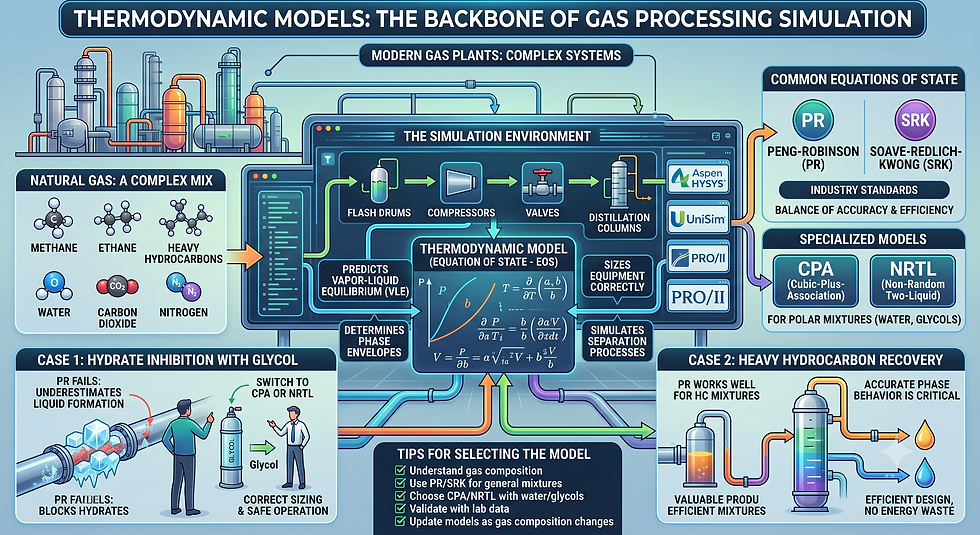
Why Thermodynamic Models Matter in Gas Processing
Natural gas is not a simple substance. It contains light gases like methane and ethane, heavier hydrocarbons, and non-hydrocarbon components such as water vapor, carbon dioxide, and nitrogen. Each component reacts differently to changes in temperature and pressure. Predicting when liquids will form from gas, or how components separate, requires precise calculations.
Thermodynamic models use mathematical equations called Equations of State (EOS) to describe these behaviors. The most common EOS in gas processing are the Peng-Robinson (PR) and Soave-Redlich-Kwong (SRK) models. These cubic equations provide a balance between accuracy and computational efficiency, making them industry standards.
Using the right thermodynamic model allows engineers to:
Predict vapor-liquid equilibrium (VLE) accurately
Determine phase envelopes for multi-component mixtures
Size equipment correctly, avoiding costly errors
Simulate separation processes like distillation and absorption
Choosing the wrong model can lead to serious mistakes. For example, PR EOS often fails with highly polar mixtures such as water and methanol or glycol, which are used to prevent hydrate formation. In such cases, specialized models like CPA (Cubic-Plus-Association) or NRTL (Non-Random Two-Liquid) are necessary.
Building the Simulation Flowsheet
Once the thermodynamic foundation is selected, engineers construct the process flowsheet. This involves connecting unit operations such as:
Flash drums for phase separation
Compressors to increase gas pressure
Valves to control flow and pressure
Distillation columns for component separation
Each unit operation relies on the thermodynamic model to predict how the gas mixture behaves inside it. For example, a flash drum uses VLE calculations to determine how much liquid condenses from the gas at a given pressure and temperature.
The simulation software integrates these units into a complete plant model. Engineers can then test different operating conditions, optimize performance, and troubleshoot potential issues without physical trials.
Practical Examples of Thermodynamic Model Impact
Case 1: Hydrate Inhibition with Glycol
Hydrate formation can block pipelines and damage equipment. To prevent this, glycol is injected into the gas stream. However, glycol-water mixtures are highly polar and do not behave well under standard EOS like Peng-Robinson. Using PR without adjustments can underestimate liquid formation, leading to undersized equipment and operational risks.
Switching to CPA or NRTL models improves accuracy, ensuring correct sizing and safe operation.
Case 2: Heavy Hydrocarbon Recovery
In plants recovering heavy hydrocarbons, accurate phase behavior prediction is critical. The PR EOS performs well here, allowing engineers to design distillation columns that separate valuable liquids efficiently. Mistakes in phase envelope prediction could cause product losses or increased energy consumption.
Tips for Selecting the Right Thermodynamic Model
Understand the gas composition thoroughly, including contaminants
Use PR or SRK for general hydrocarbon mixtures without strong polar components
Choose CPA or NRTL when water, glycols, or alcohols are present
Validate model predictions with lab data or plant measurements whenever possible
Update models as feed gas composition changes over time
Conclusion
Thermodynamic models form the backbone of modern gas processing simulations. They enable engineers to predict complex phase behavior and design efficient, safe plants. Selecting the right model is critical to avoid costly errors and operational problems. By combining accurate thermodynamics with detailed process flowsheets, simulation software transforms how gas processing facilities are designed and managed.


Comments